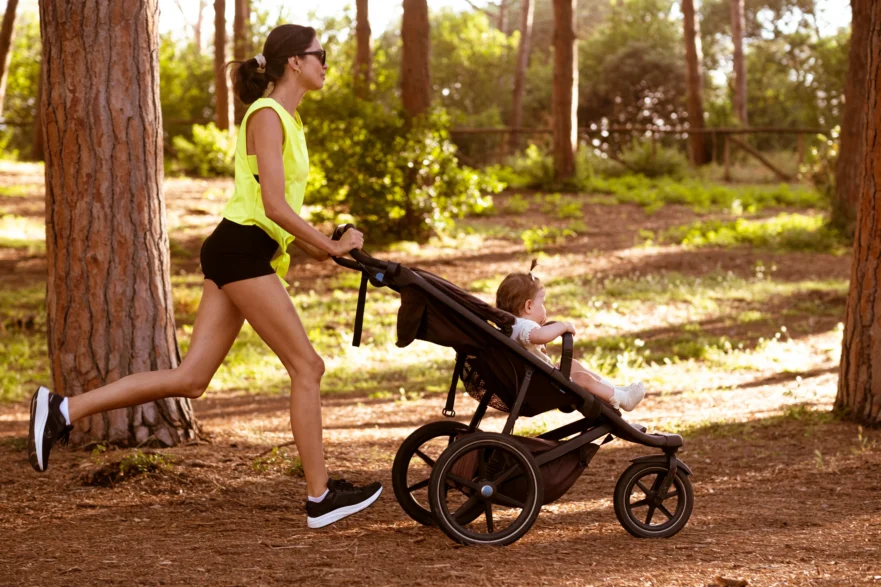
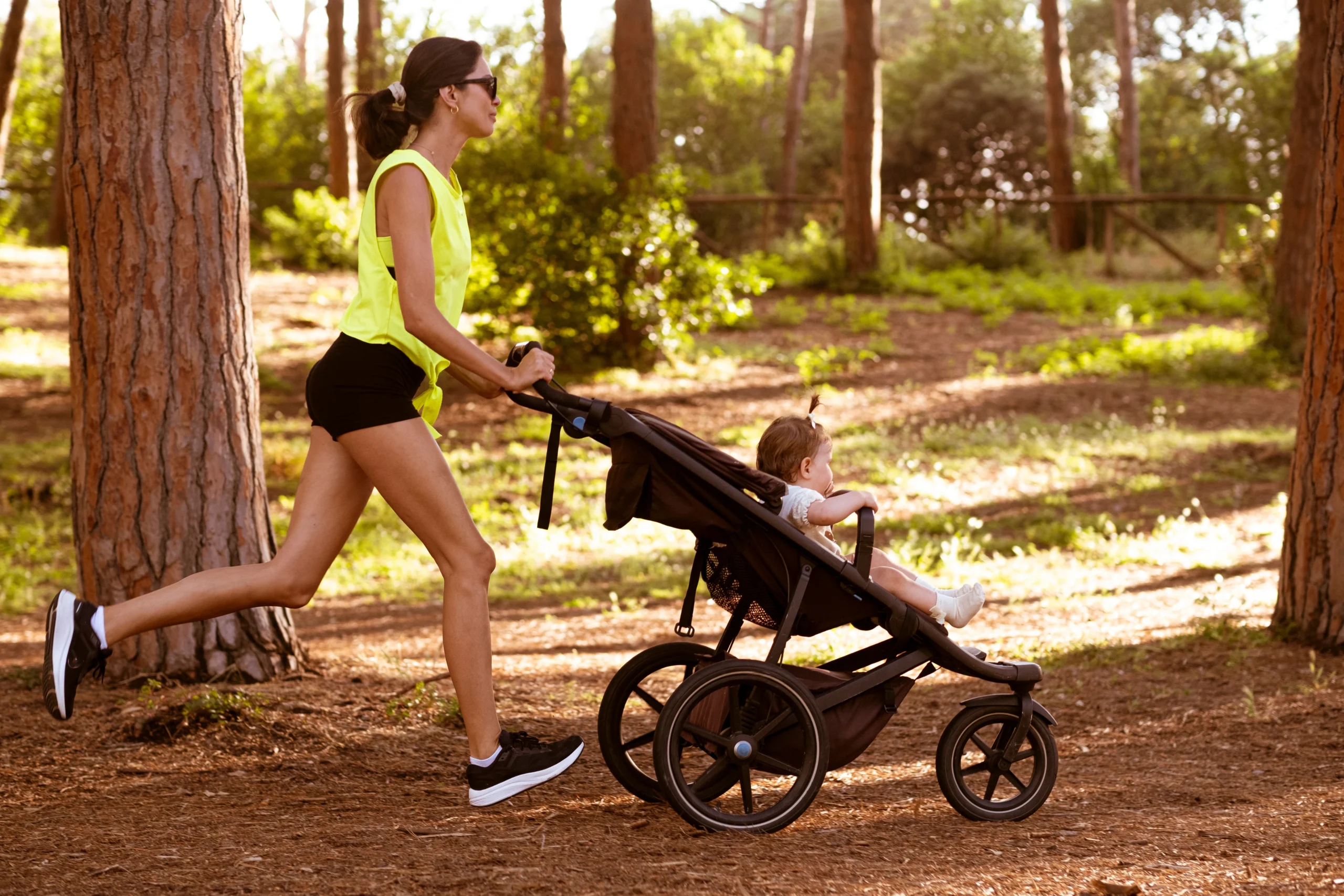
You’re exhausted, your body feels unfamiliar, and somewhere in the middle of diaper changes and night feeds, you’re wondering when you’ll feel like yourself again, maybe even lace up your shoes and go for a run. It’s a question so many postpartum runners ask, and one that deserves a better answer than “just wait 6 weeks.”
Getting back to running after having a baby isn’t about waiting for a specific week on the calendar. It’s about your body meeting a series of readiness markers, healing, strength, symptom control, and impact tolerance—that look different for every runner. Your recovery, current symptoms, strength, and response to increasing activity can all help guide when and how you return to running.
Note: This article was developed with input from Physiotherapist Karen Tyssen. The information provided is general and may not reflect your individual recovery. For advice specific to your needs, symptoms, and goals, speak with a pelvic health physiotherapist.
The 6-week green light myth: why timing isn’t everything
Many postpartum patients hear “6 weeks” and assume that’s their green light to run. In reality, your routine 6-week postpartum checkup looks at your overall health and recovery, not whether your body is specifically ready for the impact and demands of running. These are two different assessments, and treating one as a substitute for the other can lead to returning before your body is ready.
You’ve just grown and delivered a baby, and your body deserves real time and care to recover from that. Your abdominal muscles are recovering from the changes of pregnancy. Your pelvic floor is rebuilding strength and coordination, and the tissues that supported your pregnancy continue to recover. Running places repeated demands on these areas, so your symptoms, strength, and response to impact can help guide when and how you return.
What readiness to run actually looks like
Time since delivery is only one factor in running readiness, but not the most important one. Clinical and exercise professionals who work with postpartum runners have reached strong consensus on one thing: how you return to running matters more than exactly when you start.
What tends to matter more includes:
- Healing and current symptoms. Pain, pelvic pressure, or leaking are more informative than the number of weeks postpartum.
- Strength and impact tolerance. Running asks the body to absorb repeated impact, which is a different demand than general fitness or even brisk walking.
- Where your body is right now, not where it used to be. Whether you ran for years before pregnancy or are new to running matters less than your current capacity. Your pelvic floor strength, symptoms during exercise, and how well your body tolerates repeated impact and movement can help guide your return to running.
- Daily demands. Nutrition, sleep, infant care, and returning to work can all affect how well your body is recovering between sessions and your symptoms from day to day.
Every postpartum runner brings a different mix of these factors, which is exactly why a personalized assessment can provide guidance based on your individual recovery rather than a general rule of thumb. This is where a pelvic health physiotherapist can help.

How a pelvic health physiotherapist can support your return to running
Whether you delivered vaginally or by caesarean, pregnancy and childbirth change your pelvic floor, abdominal wall, and the way your whole core works together. A pelvic health physiotherapist is trained specifically to assess these changes and help you understand what your body needs before, during, and after your return to running.
An assessment can look at several factors, such as the strength and coordination of your pelvic floor, how your abdominal muscles work together, your breathing mechanics, and your overall movement patterns. These are all pieces of the puzzle that a general medical checkup isn’t designed to dig into. From there, your physiotherapist can help build a plan that’s shaped around your body, symptoms, and goals, rather than a generic timeline that may not fit your recovery at all.
This kind of support can be valuable at any stage, whether you’re planning your first run, noticing a symptom that’s giving you pause, or simply want some reassurance that you’re on the right track. Many people feel that having a professional in their corner takes a lot of the guesswork and the worry out of getting back to something they love.

Laying the groundwork before your first run
Before attempting a first run, it can help to build up through lower-impact activity first. Walking is a good starting point, and being able to walk for extended periods without pelvic floor or musculoskeletal symptoms is a commonly used benchmark before progressing toward running.
A pelvic health physiotherapist can guide a more complete readiness check. As a general guide, some of the things commonly assessed include your ability to:
- Walk for 30 minutes without pain, leaking, heaviness, or pressure
- Balance on one leg for 10 seconds on each side
- Complete 10 single-leg squats on each side
- Jog on the spot for a minute symptom-free
- Complete 10 forward bounds
- Complete 10 single-leg hops on each side
- Complete 10 single-leg “running man” movements on each side
- Complete 20 calf raises
These are general benchmarks, not a pass-or-fail test, and a pelvic health physiotherapist can help you work through them at your own pace, with modifications to your posture, pelvic floor coordination, or core strategies and breathwork if any of them are still creating symptoms.
Strength training also plays an important supporting role. Building strength in the core, hips, and lower body before returning to running can help your body better tolerate the repeated impact of running, and cross-training and strength work are commonly recommended alongside a walk-run progression rather than in place of it.
Green light, yellow light, red light: your guide to a walk-run return
For most postpartum runners, the safest way back into running is a gradual walk-run progression rather than picking up a full run straight away. A useful way to think about this is a simple traffic-light approach:
- Green: No pain, leaking, or pelvic heaviness during or after the session. It’s reasonable to continue and progress gradually.
- Yellow: Mild symptoms that show up but settle down quickly. This can be a signal to ease back on distance or intensity next time out, rather than stopping altogether.
- Red: Pain, leaking, a feeling of pelvic heaviness or pressure, or unexpected bleeding. This is a cue to stop and check in with a healthcare provider or pelvic health physiotherapist before continuing.
When progression does happen, it’s best to keep it gradual and change one variable at a time. For example, you might increase your running distance before adding more speed or intensity. Your plan may need to be adjusted based on pelvic floor or muscle and joint symptoms, as well as factors such as sleep and energy levels.

How sleep and nutrition support postpartum running
Getting back to running postpartum isn’t only about the runs themselves. A few everyday factors play a bigger role than people expect.
Sleep is one of them. Your body does a lot of its repair and recovery during sleep, so a stretch of rough nights can genuinely affect how ready you are for a session, and that’s worth listening to as much as any physical symptom.
Nutrition matters too, especially if you’re breastfeeding, since your body’s energy and hydration needs are higher during that time. Getting enough food and fluids to support your daily needs, activity, and recovery can help you maintain your energy as you gradually return to running.
None of this means your training has to be perfect or constant. Some days won’t go as planned, and that’s a normal part of postpartum recovery, not a setback.
Know the signs: when to pause, modify, or get help
Symptoms during or after a run that are worth paying attention to include pain, leaking, a feeling of heaviness or pressure in the pelvis, or unexpected bleeding.
Urinary leakage can be common after childbirth, including during running. That doesn’t mean you should ignore it or push through it. A pelvic health physiotherapist can help identify what may be contributing to it and develop a treatment plan to help reduce or eliminate symptoms and improve bladder control.
Ready to take the next step?
Every postpartum runner’s path back to running looks a little different, and that’s expected. Working with a physiotherapist can help you understand where you are in your recovery and build a plan that fits your goals.
Key takeaways
- Readiness to run postpartum depends on healing, symptoms, strength, and how your body handles impact, not just time since delivery.
- A routine medical clearance and running-specific readiness are different things.
- A pelvic health physiotherapist can assess your symptoms, strength, and movement, and help build a plan based on your recovery and goals.
- Building a foundation with walking, strength training, and lower-impact activity can help prepare your body for running.
- A gradual walk-run progression, guided by how your body responds, tends to work better than a fixed program.
- Sleep and nutrition can affect your energy and recovery as you return to running.
- Mode of delivery matters less than your current symptoms and healing when assessing readiness to run.
- Pain, leaking, pelvic heaviness or pressure, or unexpected bleeding are symptoms to pay attention to and check in with a pelvic health physiotherapist.
FAQs
When can I start running again after having a baby?
There isn’t one set timeline that applies to everyone. Readiness depends on your healing, symptoms, strength, and how your body handles impact. A pelvic health physiotherapist can help assess these factors and guide your return.
Is it normal to leak urine while running postpartum?
Urinary leaking after childbirth, including while running, is common—but common doesn’t mean it should be ignored. It can be a sign that your pelvic floor needs more targeted support, and a pelvic health physiotherapist can help identify the right approach for you.
Is leaking during running always caused by a weak pelvic floor?
Not necessarily. Leakage can be related to pelvic floor strength, timing, coordination, or other factors, including being too tight. A pelvic health physiotherapist can assess what may be contributing and recommend an approach based on your needs.
Does having a caesarean section change when I can start running?
A caesarean can affect healing time and what your body needs along the way, but mode of delivery isn’t the main factor in readiness on its own. Your current symptoms and an individual assessment are what help guide when you return to running.
What happens during a pelvic health physiotherapy assessment?
A pelvic health physiotherapist typically assesses how your pelvic floor, abdominal muscles, and breathing work together, along with your overall movement and strength. From there, they can help build a plan tailored to your body and your goals, rather than a one-size-fits-all timeline.
Sources
- Christopher, S.M., Donnelly, G., Brockwell, E., et al., Clinical and exercise professional opinion of return-to-running readiness after childbirth: an international Delphi study and consensus statement.
- Deering, R.E., Donnelly, G.M., Brockwell, E., et al., Clinical and exercise professional opinion on designing a postpartum return-to-running training programme: an international Delphi study and consensus statement.
- Davenport, M.H., Ruchat, S.M., Jaramillo Garcia, A., et al., 2025 Canadian guideline for physical activity, sedentary behaviour and sleep throughout the first year postpartum.
- Goom, T., Donnelly, G., Brockwell, E., Returning to running postnatal: guidelines for medical, health and fitness professionals managing this population.
Find a clinic near you or book online to schedule an appointment with a clinician.
This blog originally appeared on Lifemark.ca and was written by Karen Tyssen, B.A. Hon KIN, MPT, MClSc-MT, FCAMPT, CFIMS, Registered Physiotherapist.